

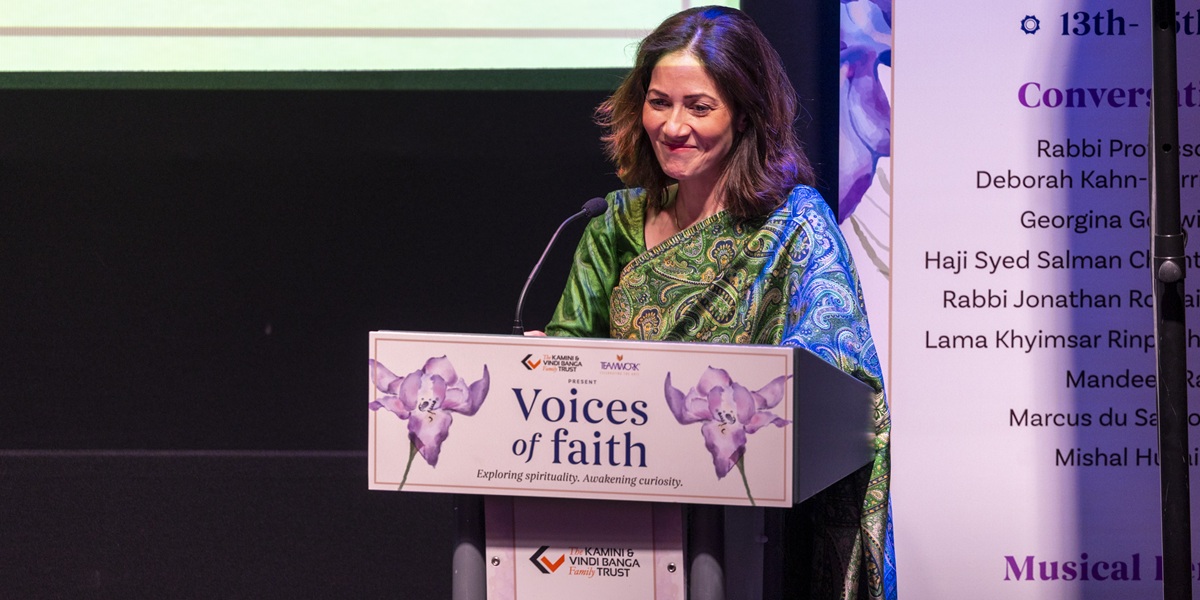
Mishal Husain’s Opening Address at Voices of Faith 2026: Threads of Memory, Faith, and Coexistence
By Subhadip Majumdar | 30 Mar, 2026
There are openings that announce themselves, and then there are those that quietly unfold, like a page turned with care, a certain sanctity inviting the listener into a deeper world. Mishal Husain’s opening address at Voices of Faith in London belonged unmistakably to the latter. It did not demand attention; it gathered it, gently but completely, holding a mirror to who we are and how history has shaped the ground beneath our feet.
She began with utmost concern that, with all the happenings in the Middle East or West Asia, whatever the "geographical starting point," faith has always been an integral part of her life. To illustrate this, she began recounting a story from 80 years ago, rooted in her grandfather’s experiences before Partition.
It was a story about Mohan Singh, who helped build the garrison town of Rawalpindi. Drawing from her grandfather’s memories, Husain recalled a time when communities of different faiths lived side by side with trust and neighbourliness, showing coexistence as a lived reality rather than an abstract ideal.
"Why do I share this story? Because it’s always touched me. Because it shows us that at the worst of times there are still examples of the most generous and the best human instincts." says Husain.
Through these recollections, she highlighted the ways in which ordinary acts of kindness and respect can persist even through the most challenging historical upheavals. The story served as a quiet reminder of a past where coexistence was deeply rooted and highlighted how personal histories can offer powerful lessons for the present, especially in understanding faith, identity, and the importance of preserving empathy across communities.
Referencing her book Broken Threads: My Family from Empire to Independence, Husain reflected on how personal histories become anchors for understanding. She recalled stories that stayed with her: a young Hindu officer pressing a box of jewellery into Tahara’s hands as she fled Delhi, an English RAF officer helping her grandparents board a plane safely so they would not risk the perilous journey across the border by train, and her own BBC documentary series on Mahatma Gandhi, where history and personal reflection intertwined. Each story, she noted, is a lens through which she understands her own life and values, showing how courage, empathy, and integrity resonate across generations.
She spoke of the present, too, in a world marked by conflict, whether in the Middle East or elsewhere, and of faith as a constant thread in her life. "We all have choices in how we see the world and perhaps in a time like this when there’s division, when some are living through war, those choices are more important than ever."
In another reflection, Mishal Husain also added in her address about Dadabhai Naoroji, where she reflects on his life and legacy as an early Indian nationalist and the first Asian MP in the British Parliament. She highlights his role in shaping ideas of representation, justice, and economic fairness during British rule. Through his story, Husain underscores how Naoroji challenged imperial narratives with data, reason, and persistence, offering a classic example of how intellect and integrity can influence public life.
Husain highlights a poignant detail: the hope, ultimately unfulfilled, that Queen Victoria might intervene and restore her family’s position after the capture of Awadh by the British in 1856, a hope that never materialised. This story reflected the quiet sense of loss and disillusionment faced by families caught between loyalty, faith, and historical upheaval.
She closed with the words of the Russian poet, Yevgeny Yevtushenko:
"No people are uninteresting
Their fate is like the chronicle of planets."
Her address reminded the audience that history lives not only in events, but in the fragile, enduring threads of human experience, memory, and empathy, threads that carry lessons for our own time and for generations to come.
Watch Full Session on

Subhadip Majumdar
Write your comment here