

The Mirror Within at Voices of Faith: Syed Salman Chishty on Sufism
By Subhadip Majumdar | 06 Apr, 2026
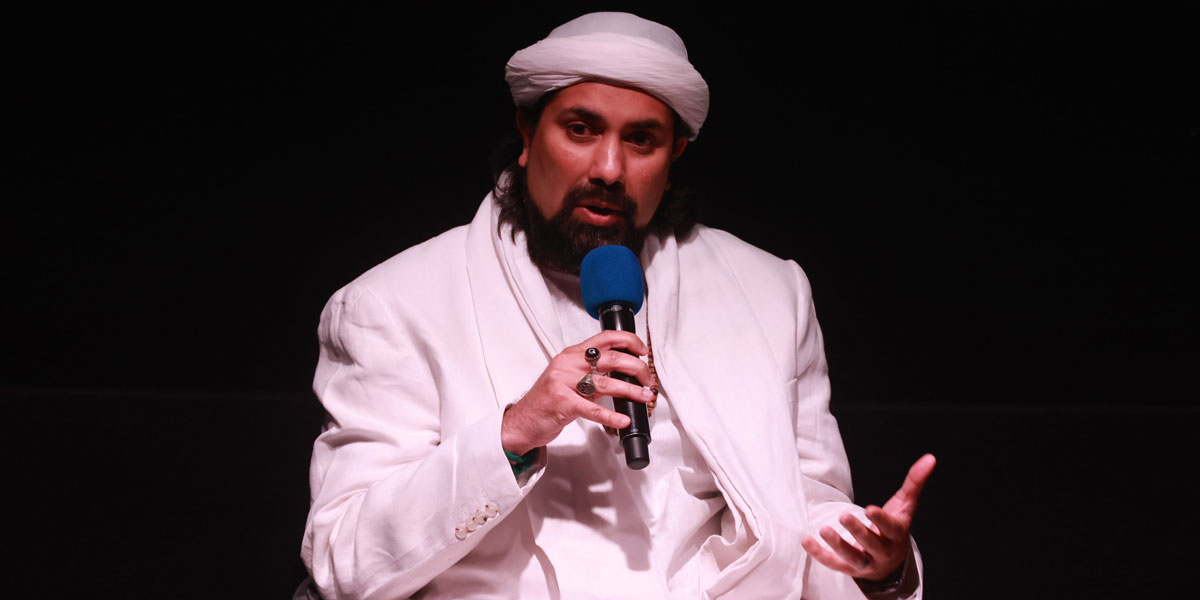
On a poignant evening at London’s Barbican Centre, Voices of Faith offered a deeply moving exploration of Sufism, where mysticism and music were intertwined into a profound spiritual dialogue. Voices of Faith weaves together philosophies that shape religious belief, theological thought, and spiritual wisdom, drawing on dialogue, insight, music, and nourishing traditions to awaken compassion. Anchored in timeless ideals of goodness, the festival illuminates the deep interconnectedness and universality of faith.In conversation with broadcaster Georgina Godwin, Syed Salman Chishty, a spiritual leader from the Ajmer Sharif Dargah, opened a window into a path that transcends identity and speaks directly to the human soul.
At the heart of his reflections was a striking truth: “Sufism is not a doctrine to be studied, but a way of being to be experienced.” He described it as “the journey from the self to the self,” an inward passage that challenges individuals to seek meaning within rather than in the external world. His words served both as invitation and introspection, urging a deeper awareness of one’s inner life.
Chishty spoke evocatively of the sacred nature of music within Sufi tradition. When words fall short, music begins. “It is the language through which the soul remembers its origin.” He said. In this light, qawwali and devotional music become more than art forms.
Love, he emphasized, is the central pillar of the Sufi path. The Sufi path is the path of unconditional love. This love is not passive. It is active, transformative, and deeply human, connecting all beings beyond divisions of belief or identity. His reflection echoed in his words: “Mother earth is ever so hospitable that she never asked who you are, whether you are a believer, non believer, saint.”
The conversation also turned toward the relevance of Sufism in today’s fractured world. Chishty observed, “We are searching for peace in the world, but peace begins when the heart becomes a place of compassion, not conflict.” He highlighted service, or khidmat, as essential to spiritual life: “To serve humanity is to serve the Divine.”
Ajmer Sharif, he reflected, is “the mirror of your own being,” a place of eternal love and surrender. Submission, he explained, is not loss but liberation. “Submission and surrender is freedom,” he said, describing it as alignment with a higher will.
It is a place where, as Salman Chishty expresses, one experiences a profound spiritual surrender. Even today, when one listens to or reads the poetry of Amir Khusrau, written 700 years ago, or reflects on the teachings of the great saint Nizamuddin Auliya, one is transported to that timeless moment, carried into the soul stirring melodies of qawwali.
In conclusion, the session offered more than insight. It offered a living reminder that spirituality resides in love, music, service, and self-awareness. As Chishty beautifully concluded, “Our doors are not of despair but doors of hope. And truly today, this voice of faith is becoming a door of hope”
His message remains as a gentle call to transform the self and, through it, the world.
Watch the Full Session

Subhadip Majumdar
Write your comment here